What we do / Our initiatives
Local Government Playbook
A practical guide to help Queensland councils use their everyday levers to support children, young people and families to thrive.
The places children grow up in shape what becomes possible.
A footpath can be more than a footpath.
It can be the connection that lets a child walk safely to school, a young person reach sport or friends independently, or a family get to the library, park or shops without needing the car.
A park can be more than an asset. A library can be more than a building. A planning decision can shape a neighbourhood for generations.
Every day, Queensland councils make decisions that help shape the places, connections and opportunities children, young people and families experience.
The Local Government Playbook – Every Child Thriving is being co-developed with Queensland councils and partners to make those connections easier to see – and to make it easier to act on them through everyday council business.
It will bring together practical Queensland examples, evidence, prompts and tools that councils can adapt to their own communities.
This isn’t about giving councils a new job. It is about seeing the potential already inside the job they do.
Why local government matters
Children grow up in places, not programs. Their everyday experience is shaped by whether they can get where they need to go, find somewhere welcoming to spend time, play and be active, connect with other people, participate in their community and feel that they belong.
Councils help create many of these conditions through decisions about:
planning, growth and neighbourhood development
infrastructure, paths and local connections
parks, public spaces, sport and recreation
libraries, cultural and community facilities and programs
community development and local activation
grants, procurement and community investment
partnerships, local leadership, community voice and local intelligence.
Councils do not control every system affecting children and families, but councils are powerful place-shapers. Their existing decisions can make everyday life easier, safer, more connected and more inclusive for people of every age.
Small decisions can change the experience of a place
Sometimes a decision or opportunity is a major new precinct or infrastructure investment.
Sometimes it is much smaller.
A shaded seat in the right place.
A crossing that joins two parts of a neighbourhood.
Teenagers considered in the design of a park.
A library program reaching families who do not usually come through the door.
A grant guideline that makes participation easier for a small community organisation.
A question asked early enough in a planning process to change what gets built.
The Playbook is about making those possibilities easier to notice.
What is the Playbook?
The Local Government Playbook will be a practical Queensland resource to help councils use the roles, assets, decisions and relationships they already hold to strengthen the places where children, young people and families grow up.
It is being co-designed as a working tool – not another report to sit on a shelf.
It will help councils:
See what is already happening
Recognise the many ways existing council activity already contributes to children, young people and families.
Ask useful questions at the right time
Bring a child, youth and family lens into everyday planning, investment, design and delivery decisions without creating unnecessary process.
Learn from other Queensland councils
See what others have tried, how they approached it, what helped, what got in the way and what could be adapted elsewhere.
Connect decisions that are often considered separately
For example, see how planning, paths, parks, shade, facilities, programs and community partnerships can together shape whether a neighbourhood works well for families.Start where it makes sense
Provide realistic options for metropolitan, regional, rural, remote and discrete communities – recognising that councils have very different operating environments, resources and priorities.
Not another checklist. A different lens on everyday decisions.
Imagine a council is upgrading a local park. The usual process might already consider asset condition, compliance, budget, maintenance and delivery timing.
The Playbook does not replace any of that.
It might simply prompt a few additional questions:
Who uses this place now – and who doesn’t?
Could a child get here safely and independently?
Is there somewhere a teenager would actually choose to be?
Can a parent or carer comfortably stay while children play?
What happens here in the middle of a Queensland summer?
Could this investment connect better with a nearby school, library, path, service or community activity?
Have the people who will use the place had a meaningful opportunity to shape it?
Those questions may lead to major changes. Or they may lead to one or two small choices – shade, seating, safer connections, flexible spaces, accessibility, better lighting or stronger links with nearby activities, that substantially change how useful the place becomes.
The council is still delivering the same project through the same core responsibilities. The lens is simply widened to help more of the potential become visible.
Built with Queensland local government
The Playbook is not being developed in isolation. Queensland Kids Partnership has brought together councils, sector partners, researchers and practitioners to test what would actually be useful in real council settings.
A Local Government Playbook Champions Group has helped create the work from its earliest stages.
Their message has been clear: build from what councils already do, keep it practical, recognise the diversity of Queensland councils and design around real decisions rather than abstract principles.
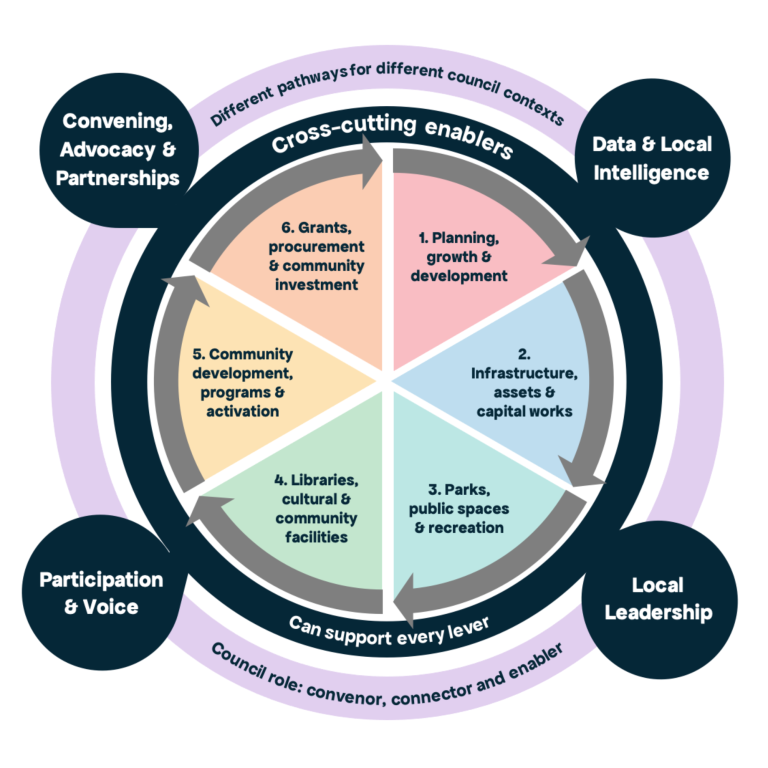
The work has progressively moved from an early map of council functions to a practical architecture grounded in 6 areas of council business, supported by cross-cutting capabilities such as participation, partnerships, local leadership and local intelligence.
Most importantly, councils have asked us not to showcase only polished success stories.
The Playbook will also learn from work in progress: what was difficult, what changed along the way, what required adaptation and what another council should know before trying something similar.
How we got here
1. Start with what councils already make possible
The project began with a simple observation: many Queensland councils are already doing work that creates better conditions for children, young people and families – often without describing it in those terms.
Rather than creating another specialist child-and-family framework, the Playbook starts with ordinary council business and asks where useful connections can be strengthened.
2. Listen to councils
Through the Champions Group, councils and partners have tested:
whether the idea is useful
the council functions the Playbook should cover
who would use it
what kinds of tools could help
where council’s role needs to be clear
how the resource can work across very different Queensland contexts.
That process substantially reshaped the original framework, including moving away from isolated topics towards interconnected council functions and cross-cutting enablers.
3. Go deeper into real work
The next phase is taking the conversation further into council practice.
Rather than asking councils simply whether they support children’s wellbeing, engagement is focused on real work:
How is a decision made?
Who is involved?
Where are the hand-offs?
What already works?
Where does it become difficult?
When can community voice make the greatest difference?
What tool, example or prompt would help?
The engagement approach includes council deep dives, practitioner conversations, existing networks and forums, Play Dates and lived-experience input where it can meaningfully improve the work.
What we are exploring
The emerging Playbook is organised around the parts of council business where decisions can shape children’s, young people’s and families’ everyday lives.
1. Planning, growth and development
How can the ways in which communities grow and change support connection, access, belonging and opportunity.
2. Infrastructure, assets and capital works
How can investment in infrastructure and local networks better respond to the people who use them.
3. Parks, public spaces and recreation
How can everyday places support play, movement, gathering, independence, inclusion and belonging.
4. Libraries, cultural and community facilities and programs
How can trusted local spaces and activities support learning, connection, participation and community life.
5. Community development, programs and activation
How can councils strengthen local capability, relationships, participation and community-led activity.
6. Grants, procurement and community investment
How can council spending and investment create broader and longer-lasting community value.
Across each of these areas, the Playbook will also consider the things that help good practice travel: participation and voice, partnerships and convening, local data and intelligence, and local leadership.
From one project to a stronger Queensland practice community
The Playbook itself is only one part of the opportunity.
Across Queensland there are councils trying new approaches, officers solving similar problems in different places, communities generating ideas and researchers building useful evidence. But too often, those lessons stay local instead of being shared across councils and communities.
The co-development of the Playbook is already creating opportunities for people across councils to compare approaches, share lessons and make new connections.
That matters because no single resource can contain every answer. A stronger practice community can keep learning long after the first Playbook is published.
That is why the work is being designed not only around a resource, but around peer learning, Queensland examples, practical tools and opportunities to keep sharing what councils learn.
Help shape what comes next
There is already extraordinary practice happening across Queensland. We want to find it, learn from it and make it easier for others to build on.
If you work in or with local government, we would love to hear from you.
Perhaps your council has:
changed how it designs parks or public spaces
found a better way to hear from children or young people
connected planning and social infrastructure
turned growth or major investment into longer-term community benefit
used libraries or community facilities differently
changed a grants or procurement approach
built an unusual partnership
found a simple idea that made an everyday council decision work better for families
tried something that did not go to plan – and learnt something worth sharing.
You do not need to have a flagship project. Some of the most useful Playbook examples may be small changes to ordinary council practice.
Share an idea. Share an example. Join the conversation.
Contact
Rowena Cann
Convenor, Places & Hubs
Queensland Kids Partnership
Rowena.Cann@aracy.org.au
Sarah Mitchell
Lead, Local Government Project
Queensland Kids Partnership
sarah.mitchell.au@outlook.com
Local Government Play Dates (Online)
Local Government Play Dates are free online sessions bringing together Queensland council practitioners, sector partners and subject experts to share practical experience and learn from one another.
Each session will combine a short presentation with facilitated discussion. The conversations will share useful practice across councils and help ensure the Local Government Playbook reflects how council work happens in different Queensland communities.
Why attend?
- Hear practical examples from Queensland councils and experts.
- Connect with people working on similar issues.
- Explore ideas that could be adapted to your own local context.
- Help shape the examples, tools and guidance included in the Playbook.
Upcoming Play Dates
Play Date 1 – Friday October 30, 2026
Keep an eye on this page, further Play Dates will be added as topics and dates are confirmed.