Title: We are all just dancing on the top soil
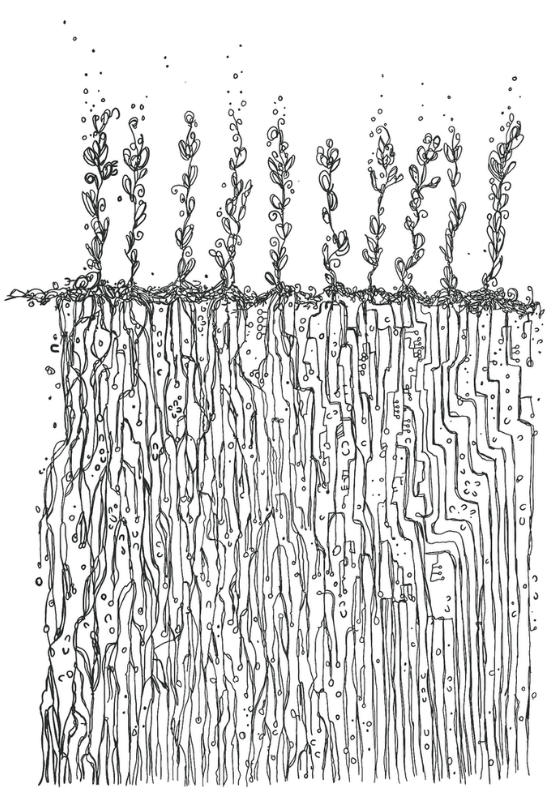
Artist: Steph Beck, Vice Chancellor of AIME Mentoring’s IMAGI-NATION {University}
Medium: Black ink pen on paper, 2026.
Drawn/ scribed live during a learning experience design session during the 2026 design residency with Queensland Kids Partnership for the Change Facilitator Program.
Short description
We Are All Just Dancing on the Top Soil was drawn/ scribed during a learning experience design session with Queensland Kids Partnership. Ten seedlings sit above deep roots that move from woven, relational grounds into the straight boxed lines of inherited systems, and each seedling is also a three thousand-year-old tree, an elder. The work is a map, an invitation to find yourself/ ourselves in, and a timely reminder that we have all grown things.
Long Description
This artwork was drawn/ scribed during a learning experience design session, as people from many places sat in circle to imagine how the Change Facilitator and System Weaver programs might grow.
Its title comes from insights offered inside the rooms we gathered in, that for all our talk and aspirations of systems and change, “ we are all just dancing on the topsoil”.
Across the surface, ten seedlings sit; each is small and new, like these programs in the first years. Each can also be seen at another scale, an ancestor, a three-thousand-year-old tree with many small figures nested against the trunk and up the canopy.
Beneath the surface, the roots run deep and differ from one another in their own way; one side is woven, organic and interconnected, with U shapes marking places where people gather, sit and trade together.
This map was laid down long before we arrived, and they hold a whole landscape of failure that is ours to compost and learn from. The lines migrate to straightness, branching into small square-shaped structures that represent the interfaces we cross in this work, from full relational places to those of bureaucracy, philanthropy, reporting, outcomes, impacts and deliverable dizziness.
The artwork also carries stories of caution. Systems change is less healthy when we speak broadly of “the system” without naming which one/s and analysing them because ultimately, we are the system, and this work challenges society’s current perception of what the self is. The work is more alive and in movement when we talk about the problems and the solutions together as two sides to the same coin, to see them existing in constant companionship so we can also stretch to places where we look at valuing what inherited metrics miss, such as joy, time, place and our relationships with other species and each other.
The depth of the roots remind us of ancestral intelligence we all hold below the surface, beyond what we know and who we know.
It is a reminder that we have all grown things, that this work sits firmly in the long story, that the knowledge has always been here; it’s the relationships that are missing to produce it healthily and have it find its way back to the land, skies and waters.